Showing posts with label seedlings. Show all posts

Thursday, January 19, 2012

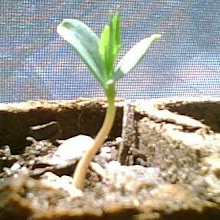
Orange Seedlings, 3 months.

They're now 3 months old.

I noticed a little mold on top of the dirt in some of the cups. I took them out of the upside-down-reused-store-bought-cake cover, and cut a few more drainage holes in the bottom of a few of the cups. (Remember, all these containers are re-used.)

I looked it up online, and it turns out that a mixture of hydrogen peroxide and water is both

1) a mold-killer and
2) a plant food.

Go figure.

I watered them a week ago with a mixture of 1c water to 1.5 tsp 3% hydrogen peroxide, and they seem much healthier and happier. The new leaves have been growing in even faster.

This is the same plant as the one pictured in my last orange seedling blog entry (direct link to the photo)


This is the biggest of the new generation of leaves:


I just like how this one looks like a dancer:

Friday, December 30, 2011

Orange Seedlings, 2 months. Plus, a little happy avocado.

My orange seedlings are now 2.5 months old!

Given my track record with seedlings, I find I'm constantly waiting for the other shoe to drop... trying not to hope too much, or get too excited about anything... Honestly, though, these are a TON easier than the apple seedlings I was always trying to grow. Apples are so susceptible to root rot. Overwater them even a little, and they're done.

Citrus is different, somehow. Either that, or I've learned not to fawn all over the things. There's an art to knowing how much water to give to a plant.

I got all excited because they unfurled their first true leaves. Then they settled in for awhile, and didn't do anything. Which is something that always makes me nervous, because when the apple seedlings stopped growing, it meant they were dying. I think, though, that in healthy plants, they alternate growing upwardly and downwardly.

Within the last week or so, they started putting out a second set of leaves. I think I need to give them some compost tea soon.


And here we have a little avocado pit. I had no intention of sprouting an avocado pit, but Shane said, "try it," so... I did.

I have two of them going, but only one put out a root. It's pretty easy to start them, just put them pointy side up in some water. They need to be suspended because the root needs some space to descend. I peeled off some of the skin to speed things up. Most of the instructions I saw called for folks to actually stick toothpicks in the pit to keep it suspended, but I didn't think it was good practice to put holes in a seed, so I'm using an old onion mesh bag. I'm probably going to cut it a little bigger around where the root is so that it doesn't get strangled.

Wednesday, November 9, 2011

Orange Seedlings: Timelapse

You may be getting the vague impression that I'm REALLY EXCITED about my li'l orange seedlings...


You'd be right!

Monday, October 31, 2011

Orange seedlings


Sprouted around October 10, planted October 15. (I dunno if that's 2 or 3 weeks of growth.) They're still alive, and hopefully will continue to grow. Sunlight's getting weaker and I've just got the one little CFL to supplement their growth. Plus, it's chilly in here (air temp is 60 degrees) so I put a little heat pad under them (with auto shut-off) to try to boost the soil temps.

I put up a little timelapse on my tumblr, 'cos it's easier to scroll through the pictures.

Wednesday, October 12, 2011

Botanical anecdotes in Autumn.

Autumn!


Leaves!

Red maple and red oak. We’re seeing a lot of red, but I saw some poplars the other day that were starting to show off their yellow. The reds are my favorite, though, especially when you see that one tree that seems almost neon red, popping decisively from the autumn wash of landscape.

Anyway, I’m trying a thing.

In the history of seeds I’ve sprouted, there was once an orange. I think it lasted a week before I finally fried it out in the sun. That was 2009. I’ve learned a thing or two since. Primarily things about patience with tiny delicate organisms.

I am constantly on the lookout for seeds. If I eat a thing that has seeds, I will try to save the seeds and sprout them. I’ve sprouted probably hundreds of apple seeds. And now, hopefully, a batch of orange seeds from a really seedy orange I knew once...

I’m not good at plant care. Like, at all. There’s a friend of mine who’s awesome at it, and she had the incredible misfortune of hiring me to mind her house while she vacationed with family this summer. She didn’t leave long enough for me to do permanent damage, but there were all kinds of things in her instructions that I was pretty sure I would have figured out eventually.

I enjoy caring for plants, though, because I always find little messages from God.

Mint, for example, a tenacious little plant, can be encouraged to root if you mash a sprig of it into the dirt. And cutting it off at the top, the main bent of its growth, forces it to branch out. So, if you find yourself facedown in the dirt, or if you are suddenly stopped - look for the other ways you can grow.

My strawberry plant returned this year with a vengeance. It had rooted its runners into every other pot before I even noticed. Not every runner found a spot to root, but most did. Lesson learned: rabid enthusiasm breeds success.

I cared for my own first tomato plant this summer. (Yes, I somehow got to be this old without ever having my own tomato plant.) I found out that tomatoes need a TON OF WATER. In fact, I kept having little hard green tomatoes that refused to ripen until I began dousing the thing with water. Just another notion of fairness not being equalness, but being “everyone gets what he or she needs.”

And, despite having just the tomato and the pepper plant - I lost some veggies just because I didn’t pick them when they were ripe. If a thing is ripe, PICK the darn thing. Don’t sit around waiting for bugs to eat it. Cause they will.

Anyway, enough of these botanical anecdotes. With any luck, I’ll have the patience to properly care for some orange seedlings, once they (hopefully) start to sprout...

Sunday, August 22, 2010

Not that I'll get any pumpkins, but hey

I had these apple seedlings. I loved them. I really did. I tried to nourish them as best I could, but I was a novice and they were high-maintenance and, well, none of them is still with me today. I had one seedling that was a few months old, and I felt pretty good in spite of the other fifty that I lost. Unfortunately, it decided that it was going to ditch all its leaves for no reason. I was wondering if maybe the poor thing thought that it was fall or something. In any case, it never came back.

The whole affair left me sort of disheartened. I have some mint, which is near impossible to destroy; I have some coneflower and black-eyed susans in the front garden, which are native to this area; I have some lavender that didn't bloom, a parsley plant, and a random strawberry plant.

But I've still never started anything from seed, which is what I want to do. Next year, I hope to actually have a garden with real vegetables in it. Or maybe do some container gardening. Anyway, you get the picture: I'm a little self-conscious about my inability to raise anything from seed.


So, I decided to try and sprout these pumpkin seeds. I know I'm late by at least a month. I know that in all likelihood, I won't get any pumpkins. But I took some heart from the fact that these might be easier to grow, being a native North American vegetable and all. I just want them to go as far as they can 'till the frost sets back in. I just want to be a good plant mommy.

I guess I need to plant them somewhere... soon...

Friday, July 24, 2009

Baby apple trees

Over the last few months, I've been working very diligently on my experiments in growing plants. Working so diligently, in fact, that I managed to destroy most of them!

The main thing I've learned about plants is that you do more by doing less. In the beginning, I just wanted to be a good plant mommy, and water my plants all the time, and spoon-feed them little drops of sunshine, etcetera. Since then, I've learned that plants are not like babies. Plants are more like teenagers. They just want to do their own thing. If you dote on them, they wither.

(I base this statement on my own experience with being a teenager, which wasn't too long ago; I was a bitch, Mom would agree.)

Mostly, I overwatered. Overwatering killed maybe ten or twenty apple seedlings, my one chamomile shoot, my random garlic cloves, and my one orange seedling. Rest in peace, guys.

Since then, I've decided to stick with sprouting apple seeds, since I've always got a supply of them. The mint is also around, but it's infested with aphids and some other bug that makes a really sticky substance. It's irritating.

I've learned so much. At the beginning, this was my mindset:
  • Plants need soil, water, and sunshine.
  • If a plant gets all three of those things, it should grow.

Now I know:

  • Each plant is a little different.
  • Plants generally need soil that drains well, a little water, a lot of sun or fluorescent light, adequate air flow, and an appropriate temperature range.
  • Apple seedlings like soil that drains well, very little water, tons and tons of light, cool temperatures, and high humidity for their little leaves.

Now I have something like ten apple seedlings, and only a few of them succumbed to root rot. So I can pat myself on the back a bit.

Here's the method that's finally yielded results, if you're curious:

  1. Sprout the seeds. Check the seeds in the apple. If they're already sprouting, put them in a moist paper towel, and put that inside a plastic baggie. (Or, for a non-disposable option, use a washcloth or rag and put it in a tupperware or other sealed container.) Wait one week. If they're not sprouting, dry them for 1 week. Put them in the moist paper towel + baggie apparatus, and put that in the fridge for 3-4 weeks (checking every week). Take it out, and wait one week.
  2. You should have at least some seeds with a white tail sticking out. These are your future apple trees. Throw away the seeds that didn't sprout.
  3. Prepare a home for your seedlings. I like to convert plastic containers into pots -- plastic cups, yogurt cups, water bottles chopped in half. Punch three or four holes in the bottom, and fill it with potting soil. For best results, you'll want one for each sprouted seed, but I tend to stick them two or three to a pot. Another small tip: I found it's easier to use clear plastic containers and fill them half full of soil, and you'll see why in a second. Water the soil until water flows from the bottom, and let it drain until there's no more water coming out.
  4. Plant your seeds. Make a little dent with your finger, put your seed in there with the root pointing down. Cover the root gently with soil. I find I get the best results if I let the seed rest on the top of the soil, or very near the top.
  5. Create good growing conditions. This means light, and lots of it, temperatures from 60-75ish, good humidity with adequate air flow, and moist soil. Basically, here's how I do it: cover the top with a plastic baggie, and punch some holes in it. (That's why it's handy to use half-full clear plastic containers; they admit light, and your seedlings won't be crushed by the baggie.) Since it's summer and it's too hot out for these guys, I keep them inside on my shelf all day, and I use a CFL bulb to give them light from about 7 AM - 10 PM. I've got a few at work, and they only get light from 8 AM -5 PM, but they seem to do all right.
  6. Let 'em be. They'll shoot right up in a matter of days. I water mine maybe once every week or two. And I water from the bottom, not the top. Just put some water in a shallow dish and set the pot in the water; the soil soaks it right up through the drainage holes. You can still overwater this way, so be conservative. Apple seedlings like it a little on the dry side; a little on the wet side will kill them, easily. Just note that you should really try to alternate watering from the top and the bottom, so that the salt doesn't build up too much in the soil. The only time I intervene is to pull off the woody seed case. Generally they should be able to cast 'em off on their own, but sometimes they do need help.
  7. Pull the ones that don't do well. If one gets root rot, you'll know it because it won't grow as fast as the others. When you pull it up, it'll have brown roots that are sort of soggy. This sort of thing is communicable, so you want to get rid of it. If they start to wilt, or if you see any brown around the roots, you want to get rid of it. They progress as such: first, they should pop up off the soil, with the seed shell still on. They cast this off, and the false leaves spread and start photosynthesizing. There'll be a little shoot between the false leaves; these are true leaves, and it's so cool to look at them every day and see how fast they grow. If the leaves look really, really super-green, you want to pull back on the watering. Light green is a good color for the leaves.

The thing you want to remember is that these guys may not bear fruit, necessarily, when they get older. And they also may not bear fruit that resembles the apple they came from. Apples these days are grafted, which I'm not really sure what that means, but you basically do something to the roots so that they grow up really small, and they produce the apple you want them to.

Johnny Appleseed, who I read about on Wikipedia, evidently did not believe in grafting due to religious beliefs. I'm with him on this one, more for ecological reasons than anything else. We really should have trees that grow tasty apples naturally. Actually, we should really have more fruiting trees in the wild, period. Because they're cool. Yeah, I won't see an apple from these guys 'till I'm 30. So? I still think it's cool.